Welcome 01
For new members & member-curious folks
On the floor 03
Walking In On A Saturday
Fig. 02 · field observations
01 ·
Sawdust on the floor.
02 ·
Someone tuning a 3D printer in the corner.
03 ·
Two members talking through a CNC fixture.
04 ·
Welding sparks behind a curtain.
05 ·
A kiln cooling overnight.
06 ·
Someone you've never met asking "Whatcha working on?!"
We're not a showroom. Tools get used, not displayed. Workbenches sit mid-project. The whiteboard has notes from last week.
A Working Shop. /// Worked-In.
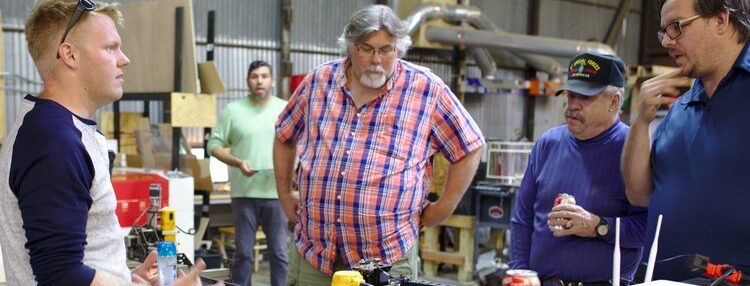
FIG. 03 · The Floor
Sat. 11:42 AM
// after orientation
The Building Runs 24/7
People come and go on their own schedules. Cleared members have card access at any hour. 2 a.m. Tuesday is a real time to be in the shop.
Getting your bearings 04
Three things tend to happen at the same time.
// on skill level
Nobody expects you to walk in fluent.
Some tools just need a walkthrough, others more training, before you run them. It's not necessarily about your skill level. More about the way those specific machines work.
Most members get proficient through some mix of all three of these.
// how learning actually happens:
01
Structured
Shop Orientation.
Specific machines need a walkthrough before you run them. That gets sorted in the orientation for whichever shop you start in. One session, maybe two if your interests span disciplines.
02
Hands-on
Members Teach Members.
Area leads run informal walkthroughs. People in the shop answer questions. You ask, you watch, you try, you ask better the second time. The shop runs on this.
03
Practice
Manuals. Videos. Reps.
The rest is the slow accumulation of practice. Read the manual. Watch the video. Do the thing badly. Do it again. Nobody's left alone, nobody gets babysat.
// the whole rule
If You're Not Sure How To Do Something Safely, Ask Before You Do It. Have Fun learning.
House rules 05
Five Lines, A Policy, A Link
Fig. 04 · ground rules
01 ·
Clean up after yourself.
02 ·
Treat the tools and area the way you'd want to find them.
03 ·
Report any damage or breakage.
04 ·
No drinking, drugs, smoking inside.
05 ·
PPE when the work calls for it.
Full version lives on the Code of Conduct page. It's worth a read before your first day.
If you damage something through misuse, or negligence, you cover the replacement. Honest accidents happen and we'd rather know than not, but the policy keeps everyone working from the same place.
The standing example is the SawStop, our table saw with a brake that fires when it senses skin or anything electrically conductive (more info.) Trip it and you're on the hook for a new cartridge and blade.
// example policy
Replacement
~$170
SAWSTOP Cartridge + replacement blade.
Member who trips it covers both.
$100 Cartridge
~$70 Blade
The SawStop is our example because it's a commonly misunderstood tool. The policy stands for any tool breakage due to user error.
Talking shop 06
Slack Is Useful. Also Optional.
Two ways members stay connected. Pick the one that fits your life. Show up either way.
// path a
Recommended
Keyboard Jockey.
The official member channel. Questions get answered there. Project pictures get posted. Classes and events get announced. Most of the day-to-day digital chatter lives there.
// channels
#maintenance-ops
#woodworking
#electronics
#general
#3d-printing
#CNC
// path b
Also fine
Offline Warrior.
Plenty of members never log in. It's one more system to keep up with. We have a contact form and a phone line for things that have to get through, and the work in the building happens either way.
// in-person equivalents
→ Make your projects.
→ Ask for help. Offer help.
→ Spend an afternoon organizing the woodshop.
→ Sweep up the lobby.
Common questions 07
Some That Always Come Up
Most questions sort themselves out once you've been in the building. These things come up enough to answer in writing.
Anything else, ask in #general or at the shop.
Extended FAQ →Fig. 05 · q + a
01
Q
Can I bring my own materials?
A
Yes, and you usually will. We stock most consumables: clay, blades, sandpaper, filament. Heavy users replenish what they use. For project-specific stuff (hardwood for a build, specialty filament, your own welding rod) you bring it.
01
Q
Where do I keep my projects?
A
Most areas have project storage. Label your materials with your name and phone number. Active projects only. Anything sitting untouched for more than two weeks becomes community property by default, with exceptions cleared through the board.
01
Q
What if something breaks?
A
Tell someone right away. Honest mistakes are part of running a working shop.